


Varicose veins on the legs are one of the most unpleasant and common diseases.This disease can cause great discomfort, harm the circulatory system and prematurely remove the natural beauty of the feet.
To be fully armed and maintain health for many years, it is important to know everything about varicose veins.
What are varicose veins on the legs?
Varicose veins (VV) affect every third representative of the fair sex who have reached the age of 30-40 years.This disease is less common in men and teenagers.
The veins in the legs have special valves.With their help, blood is only channeled insideone way (up).This valve failure resultsthe blood is allowed to move downwards (in the opposite direction to the normal direction), which interferes with its outflow.
Over the years, blood vessels lose their tone, become more fragile, and venous valves lose their ability to circulate blood effectively.As a result, blood flow throughout the body is disrupted.The appearance of fine vein networks and stars is the first sign of the development of varicose veins.
Further, the venous expansion of the veins in the legs began to develop.Veins increase in size, swell, and acquire an unhealthy bluish color.They often become inflamed and rupture, which causes discomfort, pain and severe burning.A common location for vascular formation is in the popliteal fossa and in the area adjacent to it.
In addition to the lower part of the feet, other parts of the body are susceptible to this disease:
- different parts of the hand;
- pelvic veins;
- groin and genitals
Often, with varicose veins, women are embarrassed to wear dresses and skirts and have to give preference to men's clothing styles.
Interesting facts!The term "varicose veins" comes from Latin.The word varix is translated as "knot".This disease is accompanied by the characteristic formation of vascular nodes.
What causes varicose veins: causes
Many people are familiar with the expression: movement is life.This is exactly the case with venous disease.What causes varicose veins in the legs?An inactive lifestyle is the first cause of its occurrence..Lack of proper activity has a negative effect on the condition of the blood vessels.Blood circulation deteriorates, blood stagnates and the first vascular web appears.
If there is constant pressure on the feet, the risk of developing the disease also increases.Standing for long periods of time puts undue pressure on the lower limbs, causing blood to stagnate in them.
A sedentary lifestyle is no less dangerous- it contributes to the weakening of blood vessels, and as a result, the manifestation of symptoms of varicose veins.The causes of varicose veins on the lower legs vary from person to person.
Among the most common are:
- hereditary predisposition;
- chronic stress and sedentary work;
- alcohol abuse, poor diet and overweight;
- wearing tight clothes and high-heeled shoes every day;
- taking hormonal contraceptives;
- changes in a woman's body during menopause or pregnancy.
The cause of vascular pathology in men can be heavy physical activity, excessive sports, use of saunas and excessive bathing.
symptoms
There are many signs of the development of RVV.The first thing you should pay attention to is the appearance of pain in the legs.This is the first alarm call.The diagnosis of varicose veins is confirmed if the following symptoms are present:
- throbbing pain in the location of blood vessels;
- burning sensation in leg muscles and frequent night cramps;
- pain when walking;
- feeling tired when standing;
- "Buzzing" in the legs at the end of the day
Traditional healers add psychological causes to traditional disease causes.In their opinion, a person's internal state largely affects the development or containment of the disease.
Varicose veins in the legs develop without realizing it.The first lesion most often appears in the posterior region of the knee joint(in the popliteal fossa) and on the side of the leg.Spider veins and edema are often overlooked.This small manifestation is an early sign of vascular circulation disorders.
If treatment is neglected, trophic ulcers, thrombophlebitis, bleeding from varicose veins, muscle deformation and irreversible changes in the skin may develop.The most dangerous consequence is the risk of getting gangrene or the breaking of a blood clot, which naturally leads to death.
Important to know!Advanced stages of varicose veins often cannot be treated with drugs and folk remedies, and therefore require mandatory surgical intervention.
How varicose veins develop
The disease is rapid in nature, develops and progresses rapidly.Varicose veins in the legs become the beginning of "full" varicose veins.Venous insufficiency is systemic, its characteristic manifestations are observed in various parts of the body and can coexist with hemorrhoids and other signs of disease.
The international classification below is called CEAP (Clinical Etiology Anatomy Pathology).
Phlebologists distinguish 6 stages of varicose veins:
First stagerepresents an early stage of disease progression, where increased fatigue, heaviness and swelling of the lower legs towards the end of the day, and poor development of the vascular network are observed.Sometimes, already at this stage, cramps in the calves are felt.
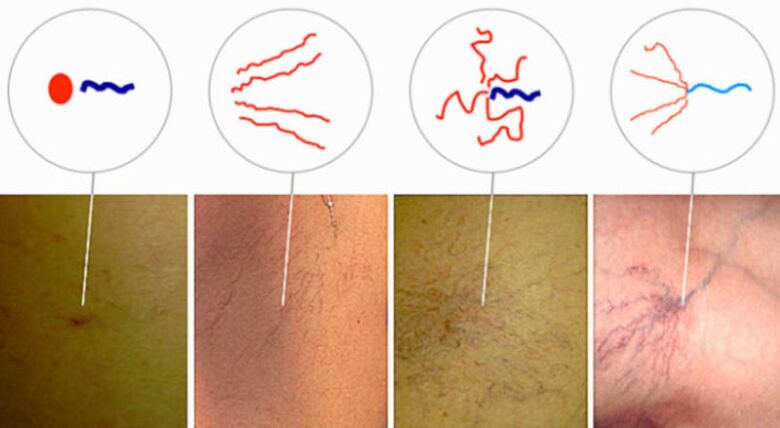
Capillaries (small vessels) expand first, then the problem ceases to be cosmetic, and the period itself can last more than a year.
Second stagecontribute to significant discomfort.The enlargement of the veins in the leg and the vascular network are very obvious, and the swelling and pain become more and more intense.Venous valves lose their ability to perform their functions.The second stage of the disease requires qualified medical treatment.
Third stagecharacterized by the constant presence of pain, severe swelling and cramping in the lower part of the leg.The veins in the legs are enlarged, and the swelling makes it impossible to wear shoes with the same comfort.These symptoms appear as a result of intense physical activity or, conversely, after a long period of limited mobility.
Fourth stagediagnosed if skin metabolism is disturbed.With that, the skin becomes covered with brownish brown spots, especially localized in the ankle area.The pigmented area of the skin thickens, and subsequently trophic ulcers form on it.If there is a risk of blood clots, the patient is advised toimmediate surgical intervention.
A description of the first four stages helps to gain a complete understanding of the development of varicose veins.
Fifth stagedetermined by the presence of keloid scars that arise after a course of trophic ulcer treatment.Often the wound reopens in the same place.
Sixth levelimplies exactly this (open ulcer).In this case, there is a need for immediate surgery;skin grafts are often performed.
Conclusion
Having information about what varicose veins are and how to treat them, you can confidently face this dangerous enemy.If you contact a medical facility on time, a qualified specialist will help solve the problem.The approach to treatment is always individual.
In the early stages, you can survive by changing the lifestyle that leads to the development of the disease.With obvious signs of venous insufficiency, complex therapy is required with the prescription of systemic drugs, local agents and physiotherapy.
The use of traditional medicine recipes can also bring many benefits, but requires the approval of the attending physician.